A cleanroom is a controlled environment where airborne particles, harmful gases, bacteria, and other contaminants are removed from a specific area. The temperature, cleanliness, internal pressure, airflow speed and distribution, air exchange rate, noise level, lighting, and static electricity are all controlled within a specified range. This creates a reliable, fully enclosed clean environment for experiments. Common cleanroom applications include HIV laboratories, PCR laboratories, biosafety laboratories, animal laboratories, pharmaceutical plants, microelectronics facilities, and food and beverage processing plants.
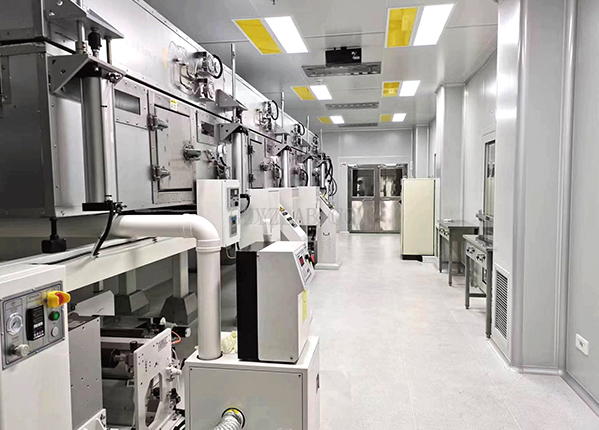
Cleanliness Level Requirements
1. Class 1 Cleanliness: Requires an extremely high level of cleanliness, suitable for high-tech industries, medical laboratories, and semiconductor manufacturing facilities. Surfaces are free of dust, bacteria, and other contaminants.
2. Class 2 Cleanliness: Suitable for areas requiring a high level of cleanliness, such as electronics factories, hospital operating rooms, and food processing plants. Surfaces are free of large dust particles and have a limited amount of bacteria.
3. Class 3 Cleanliness: Suitable for areas with general cleanliness requirements, such as offices and school laboratories. Surfaces may have some small dust particles.
4. Class 4 Cleanliness: Suitable for areas with lower cleanliness requirements, such as construction sites and public places. Surfaces may have a certain amount of dust and stains.
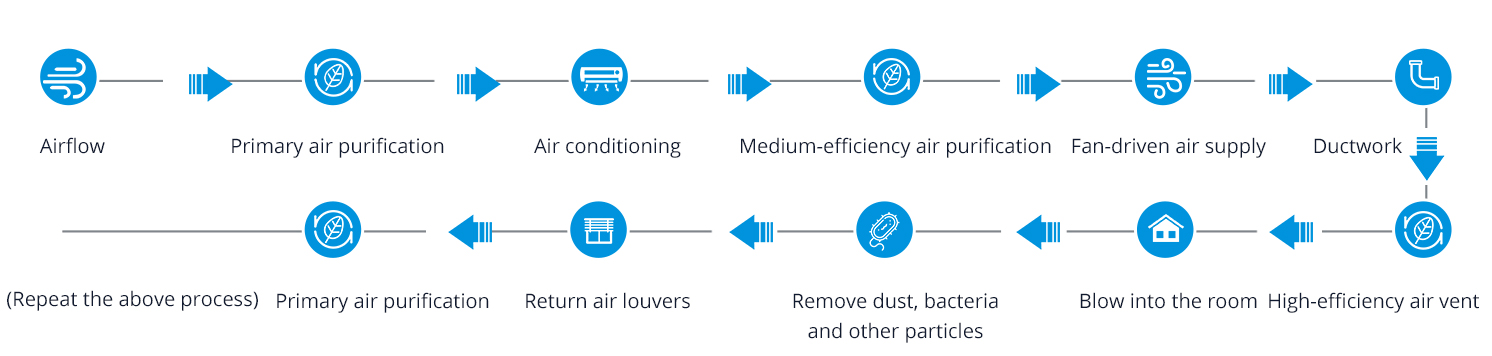
Clean air conditioning system
Direct-Flow Air Purification and Conditioning System
(1) A direct-flow system does not use a return air circulation system; it is a direct supply and exhaust system, which consumes a large amount of energy.
(2) This type of system is generally suitable for production processes involving allergens (such as penicillin packaging processes), animal laboratories, biosafety cleanrooms, and laboratories where cross-contamination is a concern.
(3) When using this system, the recovery of waste heat should be fully considered.
Fully Recirculating Air Conditioning System
(1) A fully recirculating system is one that has neither fresh air supply nor exhaust.
(2) This type of system has no fresh air load, making it very energy-efficient, but the indoor air quality is poor, and pressure differences are difficult to control.
(3) It is generally suitable for cleanrooms where there is no human operation or supervision.
Partial Recirculation Air Purification and Conditioning System
(1) This is the most commonly used system type, where a portion of the return air participates in the circulation.
(2) In this system, fresh air and return air are mixed, treated, and then supplied to the cleanroom. A portion of the return air is used for system circulation, while the rest is exhausted.
(3) This system offers easy pressure difference control, good indoor air quality, and energy consumption between that of a direct-flow system and a full-recirculation system.
(4) It is suitable for production processes that allow the use of return air.
Bio-controlled clean room
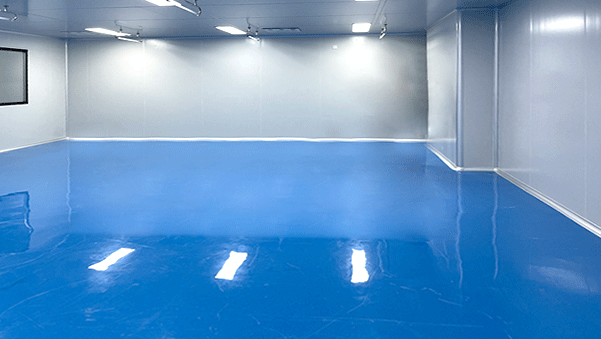
General Biological Cleanroom
Primarily controls contamination by microorganisms (bacteria). The internal materials must be able to withstand various forms of corrosion, and the interior generally maintains positive pressure. Essentially, it is an industrial cleanroom where the internal materials must withstand various treatments. Examples: pharmaceutical industry, hospitals (operating rooms, sterile wards), food, cosmetics, and beverage production, animal laboratories, physical and chemical testing laboratories, blood banks, etc.
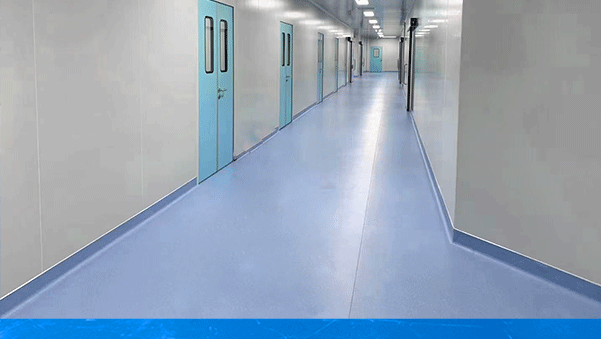
Biological Safety Cleanroom
Primarily controls the contamination of the external environment and people by living particles from the work objects. The interior must maintain negative pressure relative to the atmosphere. Examples: bacteriology, biology, clean laboratories, bioengineering (recombinant genes, vaccine preparation).
Cleanrooms are classified according to indoor air cleanliness levels into Class 100, Class 1000, Class 10,000, Class 100,000, etc.
Clean room design requirements
Rational Layout
The layout should be compact and rational, meeting the requirements for laboratory operations and air cleanliness levels, while striving for scientific and economic efficiency. Consideration should be given to laboratory requirements, future development, and operating costs.
Isolated from the outside world
Isolated from the outside world, preventing passage or interference from other factors. The size is determined by requirements, and it generally consists of a changing room, a buffer room, an air shower room, and an operating room. The changing room is on the outside, the buffer room is located between the changing room and the air shower room, and it can also be connected to several operating rooms simultaneously;
Equipment configuration:
Air shower, laminar flow hood (FFU), pass-through window, air supply vents, air volume control valves, etc. For areas requiring particularly high levels of local purification, we recommend the use of ultra-clean workstations and other purification equipment.
Purification and Filtration
Cleanrooms require a certain proportion of fresh air to be supplied to the interior. This air is purified and filtered before entering each laboratory to compensate for exhaust air, ensuring positive pressure and meeting the needs of the personnel.
ir Volume and Air Recirculation Rate
The air volume and air recirculation rate are controlled using air volume control valves to regulate different cleanliness levels in different areas, as well as to adjust the pressure gradient. This ensures that airflow moves from "clean" areas to "contaminated" areas. The pressure difference between different cleanliness levels in the cleanroom is ≥5 Pa, and the pressure difference between the cleanroom and the outside is ≥10 Pa.
Pass-through window/Observation window
The pass-through window is made entirely of stainless steel, with mechanical interlock control and internal devices. The observation window is a sealed clean window, and the door is an airtight clean door.
Exhaust vent
The exhaust vent is equipped with a filter, and the supply air vent is equipped with a filtered plenum box to ensure clean air intake. Replacing the filters is also convenient.
Return air vent
The return air vent uses a pressure relief valve to automatically regulate the indoor pressure, ensuring a positive pressure and clean environment.
Indoor Supply and Exhaust Ventilation
Generally, indoor supply and exhaust ventilation uses an upward supply and downward exhaust method. Indoor exhaust vents should be located in areas with a high risk of contamination, arranged on one side only, and free from obstructions.